Maybe she is just ignorant like so many others or just brainwashed like many naive supporters of anti-sealing businesses, but Elizabeth May is misleading the public.
Contrary to what veterinarians, scientists and experts around the world agreed on in a Royal Commission report on sealing (the facts are there), that the seal hunt is humane, perhaps more than other animal culling industry, she says it is inherently inhumane. The Commission said that the seal hunt is neither unethical or inhumane.
If sealers replaced sealing with boat tours (not sure if that's possible with heavy ice) or if someone wanted to pay off the sealers for not harvesting seals, fine, no problem from this blogger. I would not personally be able to kill cows, pigs, birds, or seals, and many people would not, but many 100s of 1000s of people are in the animal industry across Canada, and do just that. If cows, pigs, turkeys and chickens were associated with being cute and cuddly, boy, wouldn't the nutters like Paul Watson, and other purveyors of hate, be salivating with thoughts of many more million$ for their often perverted distortions of an industry and the people involved in it.
As for markets drying up for seal products, well there is an ebb and flow to many things, and new markets are possible, China and India for example. Even if the industry faded away because of low demand, fine.
But when a national party leader like May shamelessly lies to the public to make it happen, then she loses credibility, and respect. It is pathetic that she has associated herself with hate-filled activists like Paul Watson who said last year that the icy death of sealers was not as tragic as an animals. That's the animal rights activists' thinking, and they make many millions from their hate. Why people like that are not charged with hate crimes remains a mystery.
Past links on subject.

Showing posts sorted by date for query royal commission. Sort by relevance Show all posts
Showing posts sorted by date for query royal commission. Sort by relevance Show all posts
Friday, March 20, 2009


Saturday, April 05, 2008
Paul Watson: The Icy Death of Sealers is not as Tragic as an Animal's death
Watson described sealers as "sadistic baby killers" and "vicious killers who are now pleading for sympathy because some of their own died while engaged in a viciously brutal activity."

It's just another headline grabbing opportunity for Canada's King of Hate, Paul Watson, to say that it's more tragic for seals to die than it was for these men.
Why this person has not been convicted of hate crimes is a wonder. Since the 1970's this people-hating fundraiser has spewed the kinds of statements that have sent others to prison on charges of hate crimes. Paul is in the same class as two other well known Canadian hatemongers, Jim Keegstra and Ernst Zundel.
In 1990, the supreme court convicted anti-Jew, and teacher, Jim Keegstra for going beyond freedom of expression and promoting hate to his students. Ernst Zundel, author of a book called The Hitler We Love and Why, denied the killing of 6 million Jews, was put in a Canadian prison, and deported. Unfortunately, the freedom of speech argument gives these hate-loving people years of publicity, though always negative, to shine a light on their distorted and malicious viewpoints. It's the same for Paul Watson. He's been spitting venom for decades at Eastern Canadians, but yet the low-life is allowed to express his hate year after year.
Some of Watson's greatest hits of attention getting vitriol include:
There's nothing wrong with being a terrorist as long as you win. Then you write the history. (this blog, March 2006)
There are 30-million plus species on this planet. They’re all earthlings. They’re all equal. Some are more “equal” than others, I admit: earthworms are far more valuable than people. (source)
In his travelling sideshow business of hate-based fundraising, his usual laser guided target this time of year is East Coast Sealers. And it's predictable, maybe just a variation of past hate ..
I can't think of anything that defines helplessness and fear more than a seal pup on the ice that can't swim or escape as it is approached by some cigarette smoking ape with a club. (source)
Watson's level of hate for a people in at least four provinces, is ghoulish. His antics and lies have been well known for many years. What may not have been known is that Green Party leader, Elizabeth May had a close association with Watson. Now, after his comments following sealers having died, does she say she does not want to be associated with him.
Elizabeth May told the Halifax Chronicle Herald yesterday that she will resign from the advisory board of the Sea Shepherd Conservation Society.
 Well congratulations Ms May! What guts, what representation, and what a statement from you, and it only took the lives of four sealers for you to dissociate yourself from bottom feeders like Watson.
 You should have done long ago, what the fishermen in St. Pierre did, cut the ties with the extremist jerk. They deserve congratulations for not putting up with his remarks, an example for any decent person.
This time of year is the Christmas season for animal rights fundraising. They depend on continued false images and information to harvest millions of dollars for their organizations. There are surely many rational and decent people who do care for animals, but Paul Watson is not one of of them.
For anyone interested in an objective report on the humaneness of the seal hunt, here is a summary of the Royal Commission Report on Sealing, and this is a response to a protestor.
Friday, September 14, 2007
Sealed With a 
Gene Simmons of the rock group KISS is apparently considering spending some time on the Rock to protest the annual seal hunt, just like protestors do every year, via a reality tv show of course. Simmons is quoted as saying,
Yes, the idea that you could be used by animal rights activists (ARAs) groups to help continue to line their pockets by feeding you malicious lies is what you should consider delusional, Mr. Simmons. If he thinks that the seal hunt is a sporting activity then he must think that livestock farmers really laugh it up when they are out hunting chickens, pigs, and the sly slippery and elusive cow. It is hard to imagine killing animals, harder again for sport. Having heard and seen interviews with sealers you realize there is no fun, but dangerous hardship, an occupation on the sea which, like the fishery, has carried on for centuries.
Like a reality tv show, the shadowy seal hunter/monster psycho barbarian script has already been written, and the predictable fiction has had many characters play the would be hero or heroine every year. The seal hunt as Paul Watson has openly admitted to it, is the biggest fund-raiser for ARAs. As a matter of fact, in reality it is a safe bet that they do not really want the seal hunt to end because it would cripple the most lucrative fund raiser for them. So connivers like Watson and his disciples pitch images of natural tear secretions from young seals to "innocent" people like Gene Simmons and Shannon Tweed, and they fall for the idea that the poor white coats are crying like a human.
The script of misinformation, lies, prejudice and hate was written by the Shakespeares of the ARA fundraising genre. Like Othello, it's played out annually, and like Iago tricked others, the general public and celebrities are duped into believing falsehoods that are promoted with spite and hatred. What is not a tradegy, not even sad really, just irritating, is that those in public eye, celebs, show their ignorance, and impose their influence on what it has appeared to be, a shinking population, of Canadians at least, who will be blindly led to donate their money to a cause that is without foundation.
Mr. Simmons will no doubt be conducting more research into what veterinarians have to say about the seal hunt. He is bound to read their reports and consensus that it is one of the more humane animal culls, and that even included the use of the hakipik when that method was practised. Since Saturday nights are used to unwind he will probably spend time reading blogs with related information. So here's a link to read more from a report by the Royal Commission on the Seal Hunt.
Mr. Simmons, just in case you want to edit the reality tv script a little, don't forget some facts, real things that should be in a reality show. Such things are: white coat seals are no longer hunted, it is illegal to do that, and please don't let anyone try to convince you otherwise; sealing is done with rifles and not clubs; the seal hunt is short seasonal employment, and humane, and it is not a sport. One more thing, you would wish you could sell as many new CDs as the population of seals. Come out with some killer music and you will surely harvest new herds of actual music fans.
"The idea that anybody would call that a sport is delusional."
Yes, the idea that you could be used by animal rights activists (ARAs) groups to help continue to line their pockets by feeding you malicious lies is what you should consider delusional, Mr. Simmons. If he thinks that the seal hunt is a sporting activity then he must think that livestock farmers really laugh it up when they are out hunting chickens, pigs, and the sly slippery and elusive cow. It is hard to imagine killing animals, harder again for sport. Having heard and seen interviews with sealers you realize there is no fun, but dangerous hardship, an occupation on the sea which, like the fishery, has carried on for centuries.
Like a reality tv show, the shadowy seal hunter/monster psycho barbarian script has already been written, and the predictable fiction has had many characters play the would be hero or heroine every year. The seal hunt as Paul Watson has openly admitted to it, is the biggest fund-raiser for ARAs. As a matter of fact, in reality it is a safe bet that they do not really want the seal hunt to end because it would cripple the most lucrative fund raiser for them. So connivers like Watson and his disciples pitch images of natural tear secretions from young seals to "innocent" people like Gene Simmons and Shannon Tweed, and they fall for the idea that the poor white coats are crying like a human.
The script of misinformation, lies, prejudice and hate was written by the Shakespeares of the ARA fundraising genre. Like Othello, it's played out annually, and like Iago tricked others, the general public and celebrities are duped into believing falsehoods that are promoted with spite and hatred. What is not a tradegy, not even sad really, just irritating, is that those in public eye, celebs, show their ignorance, and impose their influence on what it has appeared to be, a shinking population, of Canadians at least, who will be blindly led to donate their money to a cause that is without foundation.
Mr. Simmons will no doubt be conducting more research into what veterinarians have to say about the seal hunt. He is bound to read their reports and consensus that it is one of the more humane animal culls, and that even included the use of the hakipik when that method was practised. Since Saturday nights are used to unwind he will probably spend time reading blogs with related information. So here's a link to read more from a report by the Royal Commission on the Seal Hunt.
Mr. Simmons, just in case you want to edit the reality tv script a little, don't forget some facts, real things that should be in a reality show. Such things are: white coat seals are no longer hunted, it is illegal to do that, and please don't let anyone try to convince you otherwise; sealing is done with rifles and not clubs; the seal hunt is short seasonal employment, and humane, and it is not a sport. One more thing, you would wish you could sell as many new CDs as the population of seals. Come out with some killer music and you will surely harvest new herds of actual music fans.
Thursday, March 15, 2007
Media Fails to Expose Animal Rights Activist Deception
"The seal is very easy to exploit as an image" - Paul Watson in a 1978 interview with Barbara Frum (audio clip interview)
Still today, media puts the onus on the sealing industry to be defensive rather than approach the story in a way that makes animal rights activist groups justify their methods of lying to the public to get millions in donations.
In a conversation I had with a DFO scientist who regularly goes to the seal hunt front to see observe it, the importance of the landmark Report of the Royal Commission on the Seal Hunt became evident. The report, still very valid, said that the hunt was done in a humane way. It was an extensive and comprehensive study with assessments from veterinarians and scientists, social analysts, and people involved in both sides of the issue. That was also at the time that the hakapik was used. There are plenty of other sources from veterinarian groups which also conclude that the hunt is humane.
CBC tv still uses images of the hakapik while doing stories on the hunt. For years just a small percentage of the hunt used this very humane method, and now it is not used at all. But media still chooses to use this image which is associated with the often fed image of a barbarian. That is one of the major images promoted by ARAs, in addition to the white seal pup, to lie to the public. The white coat seal has been illegal to hunt for 20 years. Still protestors will don white coat seal costumes to imply that these are the helpless animals being taken. The CBC will of course run that footage.
The Anna Nicole Smith channel (CNN) will do the same if they run out of sensational stories. CTV will probably do the same. Animal rights activists raise money through deception, and this type of story is Fifth Estate material, or W5. But the way in which major media broadcasts the annual seal hunt fundraiser/protest is just the way swindlers like Paul Watson, Ingrid Newkirk and their ilk like.
Monday, April 24, 2006
Reply to Anti-Sealer + Proof of ARA Ulterior Motives
This blog is in response to an Anti-Sealing reader who commented on my postings about the seal hunt. I will present the anonymous reader comments first, then my reply. Sorry, but there is a quirk with the apostrophes here which I am trying to work out.
(There is an audio clip further down in .ram format.
Click here to download if you need it)
(There is an audio clip further down in .ram format.
Click
here to download if you need it)| (Reader Comment) You people are quite funny. Referring to a 1985 Report - over 20 years old - to justify the commercial seal hunt of today. I'm sorry, but that's so desperately clutching at straws that it would be hilarious were not the situation so sad. I've read all the government Reports in justification of the slaughter, and if you can't see the discrepancies then I feel sorry for your chronic case of tunnel-vision. Contrary to your opinion, there are actually some AR activists who get both sides of the story, research from every angle in order to be able to put forth a valid argument. You accuse AR activists of not knowing what they're talking about, but I'm seeing here the same old arguments and observations that are incorrect. We're only interested in saving the "cute" animals? Slaughterhouses are just as bad? Celebrities are only in it for the money? Change the record, please. I'm sorry if you don't like it, but we WILL stop the commercial seal slaughter. Sealers will be forced to consider and accept one of the numerous viable employment alternatives that have been suggested to them over the last 20 years. Perhaps instead of breeding generation after generation of fishermen/sealers to live in alleged poverty while working in a failing industry, they will stop claiming there are no alternatives and will accept what has been suggested to them numerous times -- there ARE alternatives to slaughtering seals for a living. We're not looking to put anyone out of work or into bankruptcy. There have been employment alternatives suggested, none of which have even been considered by government or sealers. Research that, and you'll see that I'm right. We don't want to save the seal at the expense of the human. There is a 'win-win' situation if you people would only consider it. - Anonymous Comment |
(My Reply) Dear Sir or Madame: Thank you for your comment. I will take this opportunity to discuss the issue in further detail. I have read considerably on animal rights activists (ARAs) and the seal hunt itself, including Reports of the Canadian Veterinarian Medical Association, & Independent Veterinarians Working Group, and more. They were referenced in other blogs including the one you commented from. I knew The Royal Commission Report on Sealing was a significant study, especially after speaking with a DFO scientist who recommended it because of its relevance for today. Many things have not changed since the report first came out. For example, the sealing methods used are the same, except now, 90% of seals are killed using rifles, and white coats are no longer allowed to be killed. Even at that time, the method using the hakapik was considered very efficient. The methods were and are still considered humane, as much and perhaps even more so than methods used in abbatoirs (see Royal Commission blog below). Since you made light of an important report because of its age, let me provide you with more recent studies which approve of the hunt and methods used. Here are some key excerpts and links to the documents to read for yourself: Abstract Much attention has been given over the years to animal welfare issues surrounding the seal hunt in Atlantic Canada. However, very little information is available on this subject in the scientific literature. This article reports the results of observations made by representatives of the Canadian Veterinary Medical Association at the hunt in recent years and compares them with observations made by members of the International Fund for Animal Welfare. The conclusion is that the large majority of seals taken during this hunt (at best, 98% in work reported here) are killed in an acceptably humane manner. However, the small proportion of animals that are not killed effectively justifies continued attention to this hunt on the part of the veterinary profession. (Thanks to blogger skylarkd for sending me that link) The Canadian Veterinary Medical Association (CVMA) accepts the hunting of seals only if carried out in a humane and sustainable manner. While striking a seal with a hakapik or club is a crude act, and one unlikely to be witnessed by observers without emotion, it is a humane way to render a seal unconscious or dead when carried out correctly by a trained and skilled individual according to the suggested guidelines. (p. 9) From the Dept. of Fisheries and Oceans web site: According to a 2004 survey, the Northwest Atlantic harp seal population is now estimated at approximately 5.8 million animals, nearly triple what it was in the 1970s. Reason for Writing on the 1985 Royal Commission Report, or any Valid Seal Hunt Study One of the reasons for taking key excerpts from the Royal Commission Report was to highlight the fact that despite considerable scientific evidence, academic analysis, and ethical arguments in favor of the hunt, ARA's ignore credible reports that validates the hunt – past and present. Another reason is that it’s so comprehensive. It allowed people from many fields of expertise to contribute to the report, and welcomed the input from all concerned parties, including the anti-sealing activists. It also provides important information that is not always presented, e.g., the social, cultural and economic importance of the seal hunt to people and communities. Finally, this document is not online, so people who want solid information can get some key information starting from this blog site. Next, I will correct some things you said in your comments. First, I did not say anywhere in my writing that ARA’s are only interested in cute animals. I am aware of ARA protests and methods used in other parts of the world. However, these groups are extremely interested in the white seal pup image. As Brian Davies put it in 1970, I see the seal issue as representing a showdown for wildlife. These animals are symbolic.. (p. 72 of the 1985 Royal Commission Report). Davies knew how to use the media effectively to evoke public emotions, reactions and donations. Paul Watson, a disciple of Davies, has also mastered media manipulation.  I mean no offence, but he uses it to lure uninformed and unsuspecting people into believing in a cause which is based on fabrications, PR stunts, exaggerated and twisted scientific data. The formula of using the cute seal does not mean that ARA’s only protest the seal hunt, it simply means that this is a very big fundraiser for the ARA cousins, PETA, HSUS, SSCS and other kin I mean no offence, but he uses it to lure uninformed and unsuspecting people into believing in a cause which is based on fabrications, PR stunts, exaggerated and twisted scientific data. The formula of using the cute seal does not mean that ARA’s only protest the seal hunt, it simply means that this is a very big fundraiser for the ARA cousins, PETA, HSUS, SSCS and other kinThis is not just my own analysis. Listen to the words of Paul Watson himself as he answers questions from CBC Radio’s Barbara Frum in 1978. In the interview he blatantly admits that the seal hunt is an easy way to get money rolling in, even though the harp seal is not even an endangered species. He says that there is no way to raise money based on California’s endangered species. This is a pretty telling audiotape, and true to this day. There is a preamble for two minutes or more before the interview. Click  here to play audio. here to play audio.Below is a short segment of the interview: Click here to read the whole text of the interview.
People like Brian Davies and Paul Watson have been successful in the last 35 years in creating in the social milieu, a negative associated meaning with the term seal hunt. Over the years, and now more than ever, key negative words are used to equate sealers, Newfoundland, Newfoundlanders, and sealing with being barbaric, murderous, greedy, cruel, nazi-like, and even demented, not unlike the image of killers in slasher movies like Friday the 13th. And more obviously, the idea of clubbing a seal is not described as being an efficient method of killing, as researchers repeatedly say, but rather it is equated with something that is old-fashioned, backward, uneducated, and outdated. It seems to play to people’s insecurities about how others view Canada. It is conceivable that a celebrity like McCartney could actually say what experts tell us. People’s perception of sealers using a hakapik could really be reversed if an informed celebrity told it like it is. Imagine McCartney saying, I want everyone to know that even though it may look brutal, this method of sealing is very humane and quick. Then celebrity media could be used for factual information. Getting back to your comments, I suggested that celebrities are often misinformed and used, or simply ignorant, but they do function to attract wide attention and big cash for big payrolls. In the case of the McCartneys either this was true or they shamelessly projected an uncivilized and false image of a civilized people. But why wouldn’t PETA and other ARA’s use them to draw attention? It does increase viewers and it acts like an infomercial when the celebrities direct viewers to a web site and phone number to make donations. CNN itself is actually a window into peoples’ fixation with celebrities. For almost two years, CNN itself could very well have been called the Scott & Laci Peterson Station, or the OJ Station in 1995-96. The president of PETA, Ingrid Newkirk said about PETA’s publicity methods, PETA's publicity formula -- eighty percent outrage, ten percent each of celebrity and truth. If you still don’t think celebrities are used to bring in the goods, then consider this sample of the Larry King show with the McCartneys and Premier Danny Williams: H. MCCARTNEY: And, if you go onto www.protectseals.org you can see exactly what goes on and click on to say if you support the ban of this seal hunt, so protectseals.org and any help there donation wise can really help push this forward. It was obvious to anyone watching, that the Larry King show of was a one hour PETA advertisement. At least the first half hour of the show was devoted to Heather & Paul McCartney’s plea to the public to help and stop the seal hunt by visiting an HSUS sponsored website, and calling a number to donate. Preceding commercials, there were at least two video clips where Paul, and Heather appealled to the public to donate: (from the transcript of The Larry King Live show of March 3, 2006)
By the way, this is a snapshot of PETA’s income statement, a subject for another blog in itself. 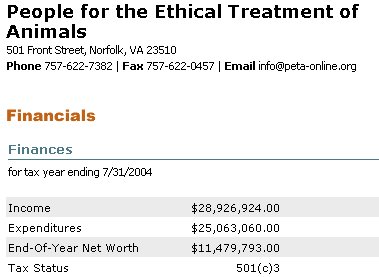 Slaughterhouse These are your words, not mine: slaughterhouses are just as bad. My point in mentioning a worker’s experience in a slaughterhouse was to reiterate what reports like those mentioned above say, i.e., that the seal fishery is as humane as regular animal slaughter. Also, the point is that any animal industry done on a white background will create a distasteful image anytime. Billions of people like to eat chicken, turkey, beef and pork, but no one wants to see a Discovery channel show of How it’s Made about how meat is harvested. For ARA’s to continually show blood soaked snow images is actually insulting to viewer’s intelligence. People know what killing animals involve. I don’t think that there are many out there who believe cattle all just pass peacefully away. Having said that, like any Canadian, I want to take comfort in knowing that an industry in my province is humane and is continually being checked and regulated like all other animal industries. That’s why I have inquired about the hunt, and referenced the above studies. Finally, it is not necessary to suggest alternate industries, as the seal fishery is humane, efficient, and contrary to what you call failing, quite successful and self-sustaining. Your use of the statement “there ARE alternatives” is just another piece of PR communications psychology, which infers to the public that, Newfoundland’s rationale for justifying the seal hunt is because we don’t think there are alternatives. Again, this is using the public’s lack of attention to and ignorance of the issue, to falsely present a situation which does not exist, thus, tricking the public. The PR used by ARA’s have gotten sophisticated enough to use this sneaky technique. A similar tactic is used when activists spokes people say that “seals did not cause the cod fish collapse.” Again, that type of statement is proclaimed to infer that Newfoundlanders exclusively blame seals for the total collapse of the cod. As Newfoundlanders & Labradorians and other educated people know, there are many factors in the cod collapse, including foreign overfishing, water temperature change, and possibly including to some degree, predators like seals. With respect reader, I’m sure you and many others sincerely have animal welfare in mind. There are plenty of places in the world where real inhumane treatment of animals take place daily. However, the ice fields off Newfoundland and Labrador are not included with them. In spite of healthy seal populations, and approval from experts and international organizations who consider the hunt humane, ARA’s still refute those findings. They will not let go of the seal hunt because it is still, as Paul Watson said, an easy way to raise money. Please consider the evidence presented here and consider carrying out animal welfare work with a more respected and honest organization. P.S. Just for your information, there are at least 8 boat tour and whale watching ventures in northern NL coastal areas where the seal hunt takes place. Also see the Department of Fisheries & Oceans website to learn more about the Myths & Realities of the Seal. |
Wednesday, April 19, 2006
1985 Royal Commission Report on Sealing Validates Seal Hunt: Limiting Access to Activists is the Best Protection for Sealers
When the most credible academic source of information like the 1985 Royal Commission Report won't stop the anti-sealing protests of animal rights activists, then nothing will, except perhaps, like Norway does, banning them from the hunt entirely. Since the seal hunt was first scrutinized in the mid 1960's, it has had to ensure that the hunt was carried out with the most efficient humane methods, and management program. As a Newfoundlander who wants objective validation of the seal hunt, I want to know that people who are best qualified, i.e., veterinarians, scientists, professionals in philosophy and law, have analyzed all sides of the issue, and then gave it an approval. Therefore, I think it is worthwhile to present important excerpts from the Report of the Royal Commission on Seals and Sealing in Canada (1985). The Commission made up of international members, wrote a very comprehensive report on seals and sealing in Canada. Department of Fisheries and Oceans scientists still view this report as still being very relevant as many facts presented have not changed.
Among the topics covered, the Royal Commission Report gives an overview of Canadian Seals, and a history of sealing; examines public concerns about sealing; addresses ethical questions regarding the killing of animals including seals; analyzes the economic, social and cultural issues involved; and scrutinizes the biological issues, including methods of killing seals.
To appreciate what an objective, valid and comprehensive report this is, I will first list how the Commission gathered its information, what sources were used, and who the members of the Royal Commission were. After, I will present key excerpts and concluding statements on key topics.
--------------------------------------------------
Sources of Information
(p. 3-9, vol. 1)
Public Submissions
Public submissions either as written briefs or in personal presentations to the Commission;
Studies undertaken by expert consultants engaged by the Commission to examine particular topics;
Information and opinion provided by experts in particular fields at the request of the Commission;
Published scientific and technical literature;
Personal knowledge, experience and research of Commission and staff
Public Hearings
There were 10 public hearings in international cities. They are: Montreal, Toronto, Vancouver, Washington, London, St. John’s, Kangiqsujuaq, Pangnirtung and Holman. A total of 156 witnesses gave oral testimony on these occasions.
Written Submissions
The Royal Commission also received a total of 137 written briefs. The sources of written briefs and oral testimony included sealers; the sealing industry; the fishing and fish-processing industries; the fur industry; representation of the aboriginal peoples; conservation, animal-welfare and animal-rights groups; veterinarians; academics in such fields as biology, economics, sociology, nutrition, philosophy and law; local development groups; elected representatives; government departments; representatives of foreign governments; and concerned individuals.
Consultants
Specific Information was frequently unavailable from witnesses, thus, the Royal Commission retained a number of consultants to carry out special studies in its behalf.
Expert Inquiries
The Royal Commission has also drawn heavily on the help and advice of people who had particular knowledge and skills in matters with which it was concerned. This help, which has been readily given, has ranged from the provision of basic facts to discussion of complex scientific issues, and even to review the preliminary drafts of technical sections of its Report.
Members of the Royal Commisson
Chairman: The Honorable Albert H. Malouf, Justice, Court of Appeal of Quebec.
Other Commissioners:
Dr. K. Radway Allen of Sydney, Australia. Formerly Chief of the Division of Fisheries and Oceanography, CSIRO, Cronulla. He has been involved for many years in research of the population dynamics and management of marine mammals.
Dr. Russell L. Barsh of Seattle, U.S. He taught law and public policy at the University of Washington until 1984.
Dr. John A. Gulland of Cambridge, England. At the time of this report, he was Senior Research Fellow, Centre for Environmental Technology, Imperial College, London.
Professor Ian McAllister of Halifax, Canada. At the time of this report, he was
Professor of Economics, Dalhousie University.
Dr. Wilfred Templeman of St. John’s, Canada. Formerly Director of the Biological Station, Dept. of Fisheries and Oceans.
Dr. Patrick A. Geistdoerfer. At the time of this report, he was responsible for research in marine biology at the Centre National de Recherche, Paris, France.
--------------------------------------------------
The Royal Commission’s Summary on Humaneness of the Seal Hunt
(Keep in mind this was in reference to seals including white coat seal pups at the time, i.e., early 1980's. As many of us know, 90% of seals hunted today are killed by rifle, but even back in the 1980's the method using a hakapik was condoned by the Commission.)
"From the perspective of the victim, the clubbing of seal pups involves little if any suffering when done "properly". The kill itself is virtually painless, as the animal is rendered instantly unconscious. Virtually no stress occurs prior to the kill, and there is little evidence of stress to the mother seal or to other seals when the pup is clubbed."
(p. 193, vol. 2)
The Royal Commission’s Summary on Methods of killing seals:
"Clubbing of harp seals is as humane as, or more humane than, the methods used in slaughterhouses when both methods are carried out properly. The frequency of improper killing appears to be generally lower for harp seals than for the majority of animals in the slaughterhouses inspected.
Overall, the clubbing of harp seals by sealers from the large vessels appears to be as humane as, or more humane than, the killing methods practised in most slaughterhouses.
"Some observers, familiar with slaughterhouse operations, who have assessed the humaneness of the harp seal hunt, have similiarly considered it to be as humane as, or more humane than, the killing of food animals in slaughterhouses (Hughes, 1967; MacLeod, 1967; Jones, 1968; Platt, 1970; Jotham, 1978; Taylor, 1979). "
(p. 53, vol.3)
(Because images of a whitecoat seal pup evokes such an emotional reaction in people, animal rights groups disrespectfully dupe the public by continuing to play video footage of a type of hunt that has been illegal for 20 years. Even though academics consider the hunt humane, activists ignore this and still pursue insidious methods to trick the public. They use old film footage, abusive and insulting language, and completely alter facts. Most shamelessly, they have used professional video editing companies such as Paradore Communications in the U.S. to edit an already staged scenario (8 years ago, an IFAW film crew posed as representatives of a sports hunter magazine in the U.S. to set up a sealer who was eventually charged by the courts for alleged cruelty).
On Methods of Killing Seals
"The Royal Commission believes it is appropriate to compare the information about seals with the information available on slaughtering domestic animals in abattoirs and hunting.
Mechanical Stunning may be carried out by means of a penetrating captive-bolt stunner, a non-penetrating captive-bolt stunner, or a gun shot (Grandin, 1980a)… Essentially these operations provided no objective methods of testing that determined when an animal was improperly stunned. Instead a slaughterman would rely upon his professional experience to determine when an animal should be stunned a second time.
Manual Stunning. Lambs and young calves may be rendered unconscious by a blow to the head applied by manual means …Rowsell (1979b) reported on the clubbing of lambs with a steel bar at a Canadian packing plant.
Electrical Stunning is used especially for pigs, but also for sheep.
Carbon Dioxide Stunning is used primarily on pigs.
(p. 47 - 50, vol. 3)
----------------------------------------------------
On Ethical Considerations
Several presentations to the Royal Commission stressed that the question of the acceptability of killing of seals should be treated as an ethical and moral issue. Two versions of the basic ethical argument against sealing were put forward:
The absolutist view that killing of seals was in itself, regardless of cruelty or conservation considerations, wrong (e.g., Hamilton, 1985); and
The judgemental view, that the interests of seals should be taken into account, and that killing of seals could be acceptable only if benefits to humanity from sealing exceeded the harm inflicted on the seals (e.g., Singer, 1985)
Application of the absolutist viewpoint only to wild animals meets logical problems. To be consistent, any human act leading to the death or suffering of an animal should be opposed. As noted earlier, deliberate killing is only one element, and in most cases only a minor element, of humanity’s impact on the numbers and well-being of wild animals. Urbanization, clearing of forests, ploughing of grasslands for agriculture, and spraying to protect crops all have much more harmful effects on the ecosystem and the general welfare of animals than have properly controlled levels of hunting….
Adoption of an absolutist attitude also implies as its logical extreme that animal rights always take precedence over human interests. Most upholders of animal rights would reject this concept.
(p. 95-96, vol. 2)
Should Seals be Killed?
"If we are to accept the killing of hundreds of millions of animals for human consumption, which, in spite of legislation, involves a degree of physical suffering and mental trauma far in excess of that suffered by the seal, then it seems difficult to understand how the proper killing of seals can be considered unethical. (Hughes, 1985)
(p. 191, vol. 2)
"... it is also clear that by and large, those who would not immediately rule out all killing of animals as a matter of principle agree on certain limiting factors. These factors must be taken into account in determining whether a given operation that involves killing seals (or other animals) should be considered acceptable:
The first two points can be settled by reference to objective and verifiable facts, such as how much pain is inflicted, or what is the status of the stocks.
Regarding the importance of sealing, many argue that the ultimate use of many sealskins to make luxury coats or other products which the wearer could well do without is an important consideration in determining whether seals should be killed. When judged only by such end uses much sealing can be seen as trivial and thus, from several viewpoints, unjustifiable. This seems a narrow view, for a broader view would take account of all those involved, from the seal hunter, to the processor, to the ultimate user.
The actual amount of cash earned by all but the most economically successful sealer may appear small by the standards of the average Canadian per capita income, but for many sealers it is of great consequence. Moreover, when allowance is made for all the relevant factors - the value of the meat and skins consumed by the sealer and his family, the low average income in most areas in which sealing occurs, and the absense of alternative employment, especially during the sealing season - it is clear that sealing is very important, and that the cash returns grossly underrepresent the real economic and social importance of sealing to communities directly concerned. There may be exceptions but in general, if the serving of a significant practical purpose is a criterion of the justification for the killing of animals, most current forms of killing seals are equally justifiable or more so than most other occasions of human killing animals…
In summary, therefore, consideration of the three factors identified earlier indicate that with some minor exceptions, sealing in Canada appears to avoid undue cruelty, not to threaten the stocks, and to serve important purposes.
(p. 190-195, vol. 2)
On The Anti-Sealing Movement
"Protests about the seal hunt began in the 1960’s. Similar to today, protesters charged that too many seals were being harvested and claimed that this was endangering the species. Frequently, they charged that the killing was exceptionally cruel, and that pups were skinned alive. They claimed that it was wrong to kill helpless, nursing seal pups in front of their mothers, and that the mothers wept over the carcasses of their young; that sealers made very little money from the hunt; and that there was no need for the products of the hunt. These charges have been repeated throughout the history of the anti-sealing campaign.
Anti-sealing material emphasizes the analogies between seals and humans, through use of words that are generally used of humans such as a “baby seal”, “murder”, “innocent”, or by attributing human properties to seals, for instance in ascribing tears to sadness. Tears are a normal biological function that keep the eyes of harp seals moist, and they are not related to grief. Some groups have so often charged that seals are skinned alive, or that mother seals weep over the bodies of their babies that many readers unquestionably accept these charges as facts.
Some information handouts use emotional language to paint the sealers as the villains of the seal hunt. Amory (undated) stated:
Anti-sealing groups have been quite selective in their use of the information available about the hunt. This is not surprising in what is, in essense, a propaganda campaign, the object of which is to present a particular viewpoint as strongly as possible. For example, anti-sealing groups were selective in the information used to present their view of one of the most important issues, the humaneness of the killing. Of the more than 40 veterinarians, animal-welfare officers and biologists who have observed the hunt and assessed its humaneness, the anti-sealing groups have emphasized the observations of the only two veterinarians, Simpson and Jordan, who concluded that not only was the hunt inhumane, but also it could not be changed sufficiently to render it humane. (p. 73, vol. 2)
(This report is so relevant to today's anti-sealing campaigns. In fact, the abusive and racit-type character assasination has only intensified. Here are some examples from the news section of the Sea Shepherd Conservation Society: "the ignorantly-cruel seal killers have taken their boats into the Gulf in an effort to shoot every seal in sight... this barbaric ritualistic tradition of suffering and slaughter has begun")
Why Seals
A number of studies, such as those made by zoologist Desmond Morris and the Walt Disney interests in modifying the original form of Mickey Mouse, have investigated the attributes, explicit or implicit, that make an animal attractive. An attractive animal is well rounded, with big eyes, a large head and short limbs. Add dark eyes and white fur, and have the ideal animal. You also have the whitecoat pup. Further, add white ice, red blood and a sealer with a large club and a skinning knife, and you have a picture that will give rise to widespread public concern. It is this public concern that is one of the major factors in the sealing issue. It exists quite apart from any evidence concerning the state of stocks. It is also distinct from scientific evidence about the pain felt by the seal, the time taken for the animal to reach unconsciousness or death, or the intensity of the bonds between mother and pup. The concern is also strengthened by the perceived brutality of clubbing. It is serious because sealing, unlike, say, killing in a slaughterhouse, takes place in the open and potentially under the public eye and the eye of the television camera.
Another source of a sealing problem, over and above objective concerns with conservation of the stocks or undue suffering, is the lack of knowledge of a large segment of the public, particularly in the towns, of what life in the wild is really like. It would be exaggerating to imply that men or women living in Montreal or Toronto believe that in nature no seal would ever suffer or be killed, but there does seem to be a lack of appreciation that violent death is an inseparable part of the natural system.
(As seen in the next excerpt, the Royal Commission Report provides key biological information about seals, which exposes the so-called "mothers wept" description of how seal mothers react. Again, the animal rights people try to take advantage of the public's lack of knowledge, and send a false message.)
Tear Production in Seals
Mammals (and all terrestrial vertebrates) possess a number of glands that provide secretions to moisten the eyeball and, to some extent, to keep it aseptic. Two important glands continually secrete fluids to the eyes, which prevents dry eyes and serious problems from resulting. Humans possess a nasolachrymal duct or tear duct in the lower lid. This duct drains the constantly secreted fluids into the nasal cavity. Seals possess no nasolachrymal ducts… When seals are on land or on ice and their fur has dried out, tears can always be seen dribbling from their eyes, since even the normal lubricatory secretions, which in seals almost certainly comes mainly from the lachrymal glands, cannot be drained away. "
Sealing studies don't get any more credible than the comprehensive 1985 Report of the Royal Commission on Seals and Sealing in Canada. Of course other important reports since, e.g., the Independent Veterinarians's Report and the Canadian Veterinarian's Report, have validated the seal hunt. So it seems that no actual research will stop the protesters from disrupting the work of sealers, or stop them from the continuing character assasination of Newfoundlanders and other Canadians who derive economic, cultural and social value from the humane and legal seal hunt. The democratic right to free speech has been granted to animal rights groups since the 1960's. However, that right has been abused, and used to slander and disgracefully brand sealers as sadistic murderers. The time has come to keep people with malicious motives like this, far away from the seal hunt.
Among the topics covered, the Royal Commission Report gives an overview of Canadian Seals, and a history of sealing; examines public concerns about sealing; addresses ethical questions regarding the killing of animals including seals; analyzes the economic, social and cultural issues involved; and scrutinizes the biological issues, including methods of killing seals.
To appreciate what an objective, valid and comprehensive report this is, I will first list how the Commission gathered its information, what sources were used, and who the members of the Royal Commission were. After, I will present key excerpts and concluding statements on key topics.
--------------------------------------------------
Sources of Information
(p. 3-9, vol. 1)
Public Submissions
Public submissions either as written briefs or in personal presentations to the Commission;
Studies undertaken by expert consultants engaged by the Commission to examine particular topics;
Information and opinion provided by experts in particular fields at the request of the Commission;
Published scientific and technical literature;
Personal knowledge, experience and research of Commission and staff
Public Hearings
There were 10 public hearings in international cities. They are: Montreal, Toronto, Vancouver, Washington, London, St. John’s, Kangiqsujuaq, Pangnirtung and Holman. A total of 156 witnesses gave oral testimony on these occasions.
Written Submissions
The Royal Commission also received a total of 137 written briefs. The sources of written briefs and oral testimony included sealers; the sealing industry; the fishing and fish-processing industries; the fur industry; representation of the aboriginal peoples; conservation, animal-welfare and animal-rights groups; veterinarians; academics in such fields as biology, economics, sociology, nutrition, philosophy and law; local development groups; elected representatives; government departments; representatives of foreign governments; and concerned individuals.
Consultants
Specific Information was frequently unavailable from witnesses, thus, the Royal Commission retained a number of consultants to carry out special studies in its behalf.
Expert Inquiries
The Royal Commission has also drawn heavily on the help and advice of people who had particular knowledge and skills in matters with which it was concerned. This help, which has been readily given, has ranged from the provision of basic facts to discussion of complex scientific issues, and even to review the preliminary drafts of technical sections of its Report.
Members of the Royal Commisson
Chairman: The Honorable Albert H. Malouf, Justice, Court of Appeal of Quebec.
Other Commissioners:
Dr. K. Radway Allen of Sydney, Australia. Formerly Chief of the Division of Fisheries and Oceanography, CSIRO, Cronulla. He has been involved for many years in research of the population dynamics and management of marine mammals.
Dr. Russell L. Barsh of Seattle, U.S. He taught law and public policy at the University of Washington until 1984.
Dr. John A. Gulland of Cambridge, England. At the time of this report, he was Senior Research Fellow, Centre for Environmental Technology, Imperial College, London.
Professor Ian McAllister of Halifax, Canada. At the time of this report, he was
Professor of Economics, Dalhousie University.
Dr. Wilfred Templeman of St. John’s, Canada. Formerly Director of the Biological Station, Dept. of Fisheries and Oceans.
Dr. Patrick A. Geistdoerfer. At the time of this report, he was responsible for research in marine biology at the Centre National de Recherche, Paris, France.
--------------------------------------------------
The Royal Commission’s Summary on Humaneness of the Seal Hunt
(Keep in mind this was in reference to seals including white coat seal pups at the time, i.e., early 1980's. As many of us know, 90% of seals hunted today are killed by rifle, but even back in the 1980's the method using a hakapik was condoned by the Commission.)
"From the perspective of the victim, the clubbing of seal pups involves little if any suffering when done "properly". The kill itself is virtually painless, as the animal is rendered instantly unconscious. Virtually no stress occurs prior to the kill, and there is little evidence of stress to the mother seal or to other seals when the pup is clubbed."
(p. 193, vol. 2)
The Royal Commission’s Summary on Methods of killing seals:
"Clubbing of harp seals is as humane as, or more humane than, the methods used in slaughterhouses when both methods are carried out properly. The frequency of improper killing appears to be generally lower for harp seals than for the majority of animals in the slaughterhouses inspected.
Overall, the clubbing of harp seals by sealers from the large vessels appears to be as humane as, or more humane than, the killing methods practised in most slaughterhouses.
"Some observers, familiar with slaughterhouse operations, who have assessed the humaneness of the harp seal hunt, have similiarly considered it to be as humane as, or more humane than, the killing of food animals in slaughterhouses (Hughes, 1967; MacLeod, 1967; Jones, 1968; Platt, 1970; Jotham, 1978; Taylor, 1979). "
(p. 53, vol.3)
(Because images of a whitecoat seal pup evokes such an emotional reaction in people, animal rights groups disrespectfully dupe the public by continuing to play video footage of a type of hunt that has been illegal for 20 years. Even though academics consider the hunt humane, activists ignore this and still pursue insidious methods to trick the public. They use old film footage, abusive and insulting language, and completely alter facts. Most shamelessly, they have used professional video editing companies such as Paradore Communications in the U.S. to edit an already staged scenario (8 years ago, an IFAW film crew posed as representatives of a sports hunter magazine in the U.S. to set up a sealer who was eventually charged by the courts for alleged cruelty).
On Methods of Killing Seals
"The Royal Commission believes it is appropriate to compare the information about seals with the information available on slaughtering domestic animals in abattoirs and hunting.
Mechanical Stunning may be carried out by means of a penetrating captive-bolt stunner, a non-penetrating captive-bolt stunner, or a gun shot (Grandin, 1980a)… Essentially these operations provided no objective methods of testing that determined when an animal was improperly stunned. Instead a slaughterman would rely upon his professional experience to determine when an animal should be stunned a second time.
Manual Stunning. Lambs and young calves may be rendered unconscious by a blow to the head applied by manual means …Rowsell (1979b) reported on the clubbing of lambs with a steel bar at a Canadian packing plant.
Electrical Stunning is used especially for pigs, but also for sheep.
Carbon Dioxide Stunning is used primarily on pigs.
(p. 47 - 50, vol. 3)
----------------------------------------------------
On Ethical Considerations
Several presentations to the Royal Commission stressed that the question of the acceptability of killing of seals should be treated as an ethical and moral issue. Two versions of the basic ethical argument against sealing were put forward:
The absolutist view that killing of seals was in itself, regardless of cruelty or conservation considerations, wrong (e.g., Hamilton, 1985); and
The judgemental view, that the interests of seals should be taken into account, and that killing of seals could be acceptable only if benefits to humanity from sealing exceeded the harm inflicted on the seals (e.g., Singer, 1985)
Application of the absolutist viewpoint only to wild animals meets logical problems. To be consistent, any human act leading to the death or suffering of an animal should be opposed. As noted earlier, deliberate killing is only one element, and in most cases only a minor element, of humanity’s impact on the numbers and well-being of wild animals. Urbanization, clearing of forests, ploughing of grasslands for agriculture, and spraying to protect crops all have much more harmful effects on the ecosystem and the general welfare of animals than have properly controlled levels of hunting….
Adoption of an absolutist attitude also implies as its logical extreme that animal rights always take precedence over human interests. Most upholders of animal rights would reject this concept.
(p. 95-96, vol. 2)
Should Seals be Killed?
"If we are to accept the killing of hundreds of millions of animals for human consumption, which, in spite of legislation, involves a degree of physical suffering and mental trauma far in excess of that suffered by the seal, then it seems difficult to understand how the proper killing of seals can be considered unethical. (Hughes, 1985)
(p. 191, vol. 2)
"... it is also clear that by and large, those who would not immediately rule out all killing of animals as a matter of principle agree on certain limiting factors. These factors must be taken into account in determining whether a given operation that involves killing seals (or other animals) should be considered acceptable:
- the degree of cruelity inflicted
- the conservation of the seal stocks and the environment in which they live
- the importance of sealing and the products of seal to those engaged in this activity, including the importance of any benefits to fishermen if culls of seals were undertaken to protect fishing interests.
The first two points can be settled by reference to objective and verifiable facts, such as how much pain is inflicted, or what is the status of the stocks.
Regarding the importance of sealing, many argue that the ultimate use of many sealskins to make luxury coats or other products which the wearer could well do without is an important consideration in determining whether seals should be killed. When judged only by such end uses much sealing can be seen as trivial and thus, from several viewpoints, unjustifiable. This seems a narrow view, for a broader view would take account of all those involved, from the seal hunter, to the processor, to the ultimate user.
The actual amount of cash earned by all but the most economically successful sealer may appear small by the standards of the average Canadian per capita income, but for many sealers it is of great consequence. Moreover, when allowance is made for all the relevant factors - the value of the meat and skins consumed by the sealer and his family, the low average income in most areas in which sealing occurs, and the absense of alternative employment, especially during the sealing season - it is clear that sealing is very important, and that the cash returns grossly underrepresent the real economic and social importance of sealing to communities directly concerned. There may be exceptions but in general, if the serving of a significant practical purpose is a criterion of the justification for the killing of animals, most current forms of killing seals are equally justifiable or more so than most other occasions of human killing animals…
In summary, therefore, consideration of the three factors identified earlier indicate that with some minor exceptions, sealing in Canada appears to avoid undue cruelty, not to threaten the stocks, and to serve important purposes.
(p. 190-195, vol. 2)
On The Anti-Sealing Movement
"Protests about the seal hunt began in the 1960’s. Similar to today, protesters charged that too many seals were being harvested and claimed that this was endangering the species. Frequently, they charged that the killing was exceptionally cruel, and that pups were skinned alive. They claimed that it was wrong to kill helpless, nursing seal pups in front of their mothers, and that the mothers wept over the carcasses of their young; that sealers made very little money from the hunt; and that there was no need for the products of the hunt. These charges have been repeated throughout the history of the anti-sealing campaign.
Anti-sealing material emphasizes the analogies between seals and humans, through use of words that are generally used of humans such as a “baby seal”, “murder”, “innocent”, or by attributing human properties to seals, for instance in ascribing tears to sadness. Tears are a normal biological function that keep the eyes of harp seals moist, and they are not related to grief. Some groups have so often charged that seals are skinned alive, or that mother seals weep over the bodies of their babies that many readers unquestionably accept these charges as facts.
Some information handouts use emotional language to paint the sealers as the villains of the seal hunt. Amory (undated) stated:
“He goes to meet, in a curious, friendly, playful way, the first human being he has ever see and is - by that same human - clubbed on the head and skinned on the spot - sometimes while he is still alive.
This sad, cruel episode is repeated over and over and over during the “hunt” by hundreds of Canadian and Norwegian sealers, who first kick away the mother, and then drive home their horrible message by bludgeoning the baby using a club, or the brutal spike-tipped hakapik.” (p. 70 - 71, vol. 2)
Anti-sealing groups have been quite selective in their use of the information available about the hunt. This is not surprising in what is, in essense, a propaganda campaign, the object of which is to present a particular viewpoint as strongly as possible. For example, anti-sealing groups were selective in the information used to present their view of one of the most important issues, the humaneness of the killing. Of the more than 40 veterinarians, animal-welfare officers and biologists who have observed the hunt and assessed its humaneness, the anti-sealing groups have emphasized the observations of the only two veterinarians, Simpson and Jordan, who concluded that not only was the hunt inhumane, but also it could not be changed sufficiently to render it humane. (p. 73, vol. 2)
(This report is so relevant to today's anti-sealing campaigns. In fact, the abusive and racit-type character assasination has only intensified. Here are some examples from the news section of the Sea Shepherd Conservation Society: "the ignorantly-cruel seal killers have taken their boats into the Gulf in an effort to shoot every seal in sight... this barbaric ritualistic tradition of suffering and slaughter has begun")
Why Seals
A number of studies, such as those made by zoologist Desmond Morris and the Walt Disney interests in modifying the original form of Mickey Mouse, have investigated the attributes, explicit or implicit, that make an animal attractive. An attractive animal is well rounded, with big eyes, a large head and short limbs. Add dark eyes and white fur, and have the ideal animal. You also have the whitecoat pup. Further, add white ice, red blood and a sealer with a large club and a skinning knife, and you have a picture that will give rise to widespread public concern. It is this public concern that is one of the major factors in the sealing issue. It exists quite apart from any evidence concerning the state of stocks. It is also distinct from scientific evidence about the pain felt by the seal, the time taken for the animal to reach unconsciousness or death, or the intensity of the bonds between mother and pup. The concern is also strengthened by the perceived brutality of clubbing. It is serious because sealing, unlike, say, killing in a slaughterhouse, takes place in the open and potentially under the public eye and the eye of the television camera.
Another source of a sealing problem, over and above objective concerns with conservation of the stocks or undue suffering, is the lack of knowledge of a large segment of the public, particularly in the towns, of what life in the wild is really like. It would be exaggerating to imply that men or women living in Montreal or Toronto believe that in nature no seal would ever suffer or be killed, but there does seem to be a lack of appreciation that violent death is an inseparable part of the natural system.
(As seen in the next excerpt, the Royal Commission Report provides key biological information about seals, which exposes the so-called "mothers wept" description of how seal mothers react. Again, the animal rights people try to take advantage of the public's lack of knowledge, and send a false message.)
Tear Production in Seals
Mammals (and all terrestrial vertebrates) possess a number of glands that provide secretions to moisten the eyeball and, to some extent, to keep it aseptic. Two important glands continually secrete fluids to the eyes, which prevents dry eyes and serious problems from resulting. Humans possess a nasolachrymal duct or tear duct in the lower lid. This duct drains the constantly secreted fluids into the nasal cavity. Seals possess no nasolachrymal ducts… When seals are on land or on ice and their fur has dried out, tears can always be seen dribbling from their eyes, since even the normal lubricatory secretions, which in seals almost certainly comes mainly from the lachrymal glands, cannot be drained away. "
Sealing studies don't get any more credible than the comprehensive 1985 Report of the Royal Commission on Seals and Sealing in Canada. Of course other important reports since, e.g., the Independent Veterinarians's Report and the Canadian Veterinarian's Report, have validated the seal hunt. So it seems that no actual research will stop the protesters from disrupting the work of sealers, or stop them from the continuing character assasination of Newfoundlanders and other Canadians who derive economic, cultural and social value from the humane and legal seal hunt. The democratic right to free speech has been granted to animal rights groups since the 1960's. However, that right has been abused, and used to slander and disgracefully brand sealers as sadistic murderers. The time has come to keep people with malicious motives like this, far away from the seal hunt.
Subscribe to:
Posts (Atom)